Thymelia · Single origin · The hills above Kalamata
The green harvest above Kalamata
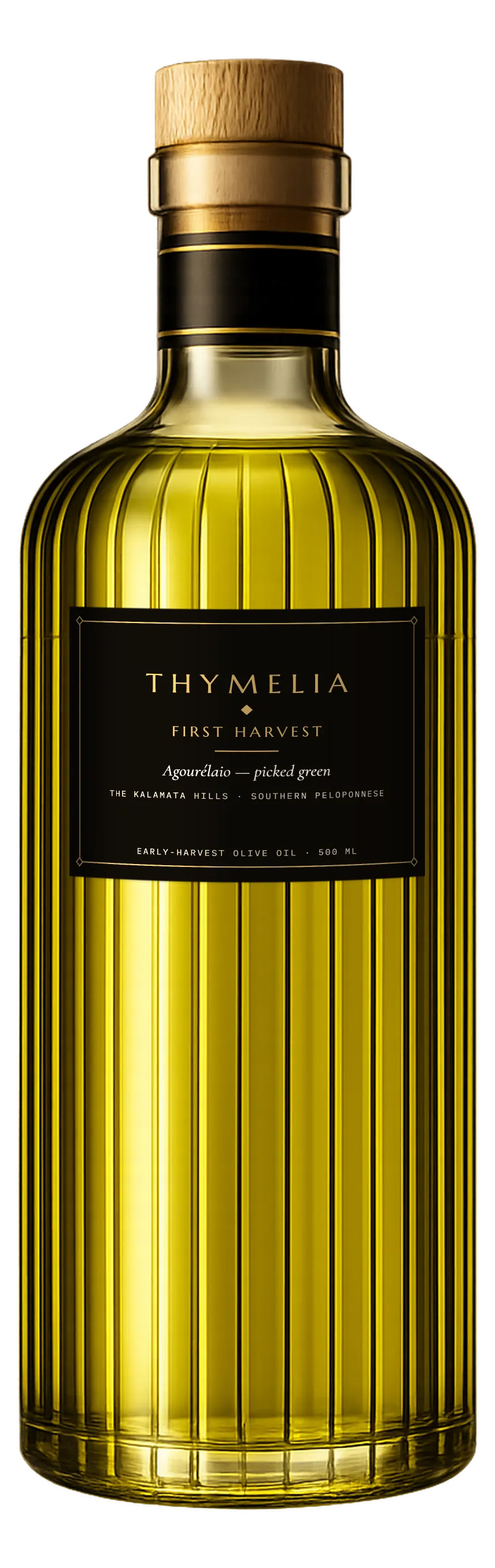
Extra virgin olive oil we are sourcing from the Koroneiki country of the southern Peloponnese — olives picked green from October, carried to the mill the same day, pressed once a season. Less oil than the trees could give, on purpose. The first harvest is still on the branches.
- Single-grove lots
- Picked green, pressed same day
- Certificate published per lot
Part I · The Early HarvestFol. 01
Flavour over volume.
The Greeks have a word for the early oil — agourélaio, from the unripe fruit. Most oil is made the other way, from dark fruit that gives generously. We buy against the early pick, and the yield it surrenders.
Picked green
The pick starts in October, weeks before full ripeness, when the fruit is hardest and gives the least. In the largest study of Greek oils, phenolic content falls steadily as picking runs from September into January — the early window is where the character is.
Milled the same day
Free acidity climbs while picked fruit waits, so the fruit waits for nothing: into the mill within hours, and extraction below 27 °C — the threshold that lets an oil call itself cold-extracted.
Never blended
One pressing a season: what the trees give that autumn is the year’s oil, and when it is gone there is no second run. The same rule the hive keeps.
Less oil, on purpose. The yield we give up is the character we keep.
What early harvest meansThe word the scribes of Pylos pressed into clay, thirty-two centuries ago.
ἔλαιον — olive oil. Written e-ra-wo in the Linear B tablets of the palace at Pylos, across the hills from Kalamata.On the age of the trade, the southern Peloponnese
Part II · ProvenanceFol. 02
The hill country above Kalamata.
The groves stand in the hills above Kalamata, in the southern Peloponnese, under the wall of the Taygetos — the heartland of the Koroneiki, the small-fruited olive behind most of Greece’s finest oil.
The grove is contracted, and the oil is certified organic. We will buy single-grove lots, never pooled tanks: each lot one grove, one pressing, one certificate. When there is a bottle, its lot page will name the grove and the mill, and print the control body and its code.
The pick runs green from October. What the trees give that autumn is the year’s oil, and we will never blend two harvests to make more.
A working chart, not a map. When the first lot is bottled, its page will plot the real grove at its real coordinates — the same ones printed on the bottle.
Part III · The StandardFol. 03
Extra virgin is the floor, not the score.
The grade is law — chemical limits and a trained taste panel — and two lawful oils can still be worlds apart. We buy against the numbers, and every lot will publish this record.
The record of analysis — published per lot
- Grove & mill
- named at bottling
- Harvest window
- picked green, from October
- Free acidity
- legal limit ≤ 0.80 %
- Peroxide value
- legal limit ≤ 20 mEq O₂/kg
- UV absorbency
- K232 ≤ 2.50 · K268 ≤ 0.22
- Panel verdict
- zero defects, fruitiness above zero
- Total phenols
- measured per lot, mg/kg
What the numbers cannot tell you: how the oil tastes on warm bread. The panel records defects and fruitiness, not pleasure — for that, open the bottle.
The producer’s certificate of analysis travels with every lot and is published on this site in full, in real units, against the legal limits — not summarised into a tick.
Lots will be numbered because each one ends. One grove, one pressing date, one certificate; when the bottles are gone, the number retires.
How the testing worksPart IV · The GuidesFol. 04
Know what you’re buying.
Plain-spoken buyer’s guides to the oil shelf — what the words on a bottle are allowed to mean, and which numbers stand behind them. Composition and process, no mythology.
Evidence
We read the research closely.
The evidence section reports it, study by study — the trials on olive oil in the diet, and the phenolic story behind the premium shelf: what was measured, in whom, and how much weight each finding can bear.
Read the evidence pagesPart V · QuestionsFol. 05
Asked, answered.
When can I buy Thymelia olive oil?
We are not naming a date. The olives come off the trees green from October and go to the mill the same day — one pressing a season, and what that pressing gives is the year’s oil. We will not publish a launch date until a lot is contracted and tested. The Harvest Letter gets first call on the allocation — join it below.
What does “early harvest” mean?
Oil pressed from olives picked green, early in the season, rather than left to ripen dark. Green fruit gives less oil and more character — the measured phenolic content of Greek oils falls steadily as picking runs from September into January — so early harvest is a choice of flavour over volume. It is the choice we have made.
What variety is the oil?
Koroneiki — the small-fruited olive behind most of Greece’s finest oil. The variety alone guarantees nothing: harvest date and the mill decide what ends up in the bottle, which is why every lot we buy must carry its own numbers.
Is Thymelia's olive oil organic?
Yes. The grove above Kalamata is contracted and its oil is certified organic. Organic certifies the method, not the grade — so the control body and its code will be printed on every lot page alongside the extra-virgin evidence, which is a separate measurement. Nothing is on sale yet.
Will the oil be Kalamata PDO?
Kalamata is a protected designation for olive oil, recognised on the GB register, and carrying it is a fact of a lot’s paperwork — certified under the scheme’s controls, or not named at all. Whether a given lot qualifies will be stated when its paperwork is in hand, and never before. Either way, the lot’s own chemistry is published in full.
Can you cook with extra virgin olive oil?
Yes. Across the olive-growing Mediterranean it is the everyday cooking fat. Heat spends aroma rather than safety, so the honest pattern is a modest extra virgin for the pan and a remarkable one for the plate. The temperatures and trade-offs are measured out in our cooking guide.
The Harvest Letter
Two letters a year. Nothing between.
One at the summer extraction, one at the autumn pressing: first call on the first jars and first bottles we fill, and the harvest report in real numbers.
No promotions between letters. Unsubscribe any time — write to care@thymelia.com and the record is deleted. Joining stores your address, the date, and the page you joined from; nothing else. What we keep.