Thymelia · Single origin · Chania, Western Crete
The thyme réserve of the White Mountains
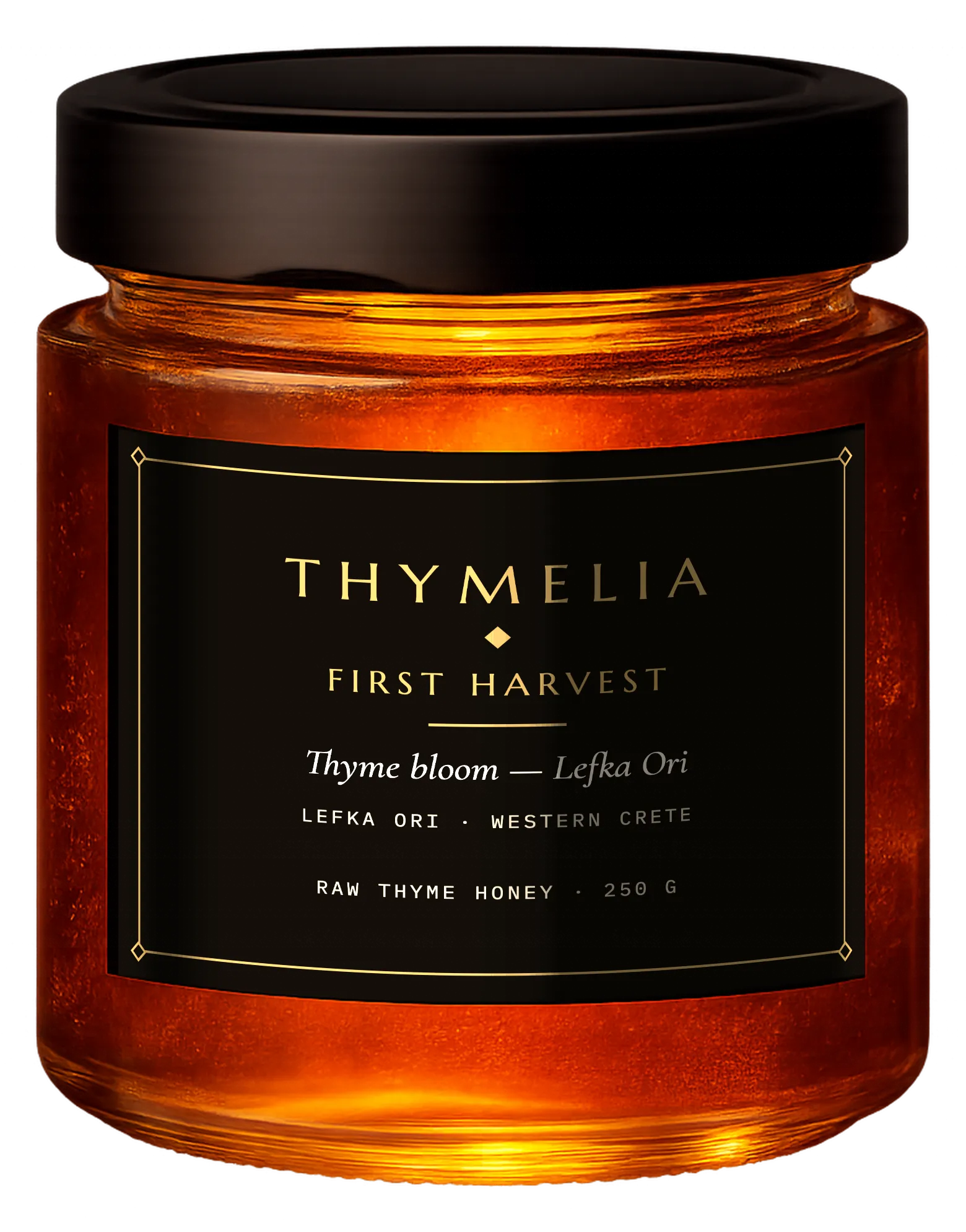
The hive is Thymelia's raw Cretan thyme honey, drawn once each summer from the Lefka Ori — the White Mountains above Chania — with fresh royal jelly preserved in nothing but the honey itself. Cold-extracted, never pasteurised, bottled unblended. The first harvest is still on the hillsides.
- Single-apiary batches
- Cold-extracted, never pasteurised
- Certificate published per lot
Part I · The MatrixFol. 01
Why the jelly will live in the honey.
Fresh royal jelly is fragile. On its own it must live in a refrigerator, and most of what is sold has been freeze-dried into powder to survive the shelf. We will do neither.
Low moisture
Thyme honey leaves the extractor at under 17.5% water — our specification for every batch we bottle. An environment too dry for spoilage to take hold.
Naturally acidic
A resting pH near 3.9. Nothing is added to achieve it; honey arrives that way from the hive.
Hygroscopic
Honey binds free water. Folded in cold at 2%, fresh royal jelly sits inside a matrix that holds it stable at room temperature.
No freeze-drying. No capsules. No cold chain. The honey is the preservation.
The word the Minoans worked in gold, a thousand years before Rome.
μέλι — honey. Two bees, bowed over a single drop, in the pendant found at Malia.On the origin of the trade, Crete
Part II · ProvenanceFol. 02
Slopes, not fields.
Wild thyme grows where little else will — on the limestone shoulders of the Lefka Ori, the White Mountains of western Crete. There are no fields to speak of, and nothing is planted. The bees work scrub that has never been farmed.
We are choosing our partner apiaries now, in the Chania region — visiting, tasting, and asking for the numbers. We will buy whole single-apiary harvests, never pooled stock: each batch one apiary, one extraction, one certificate. When the first contracts are signed, each batch page will name its apiary and plot its coordinates.
The thyme flowers from May into July. The supers come off once, as the bloom closes, and what the bloom gives that year is what exists. We will never blend two harvests to make more.
A working chart, not a map. When the first batch is bottled, its page will plot the real apiary at its real coordinates — the same ones printed on the jar.
Part III · The RecordFol. 03
The raw claim is provable, or it isn’t made.
“Raw” is the easiest word in the honey aisle and the least policed. We hold it to the measurable definition: what was never heated is still enzymatically alive, and the numbers show it. Every batch will publish this record.
The record of analysis — published per batch
- Apiary & coordinates
- named at bottling
- Extraction date
- one day, one pass
- Moisture
- house limit ≤ 17.5 g/100 g
- HMF
- legal limit ≤ 40 mg/kg
- Diastase activity
- legal minimum ≥ 8 Schade
- Pollen analysis
- thyme share of count
- Residue screen
- multi-compound
What the tests cannot tell you: how the honey tastes, or how it will set in your cupboard. Pollen analysis reads the forage, not the flavour — for that, open the jar.
The producer’s certificate of analysis travels with every batch and is published on this site in full, in real units, against the legal limits — not summarised into a tick.
Batches will be numbered because each one ends. One apiary, one extraction date, one certificate; when the jars are gone, the number retires.
How the testing worksPart IV · Field GuidesFol. 04
Know what you’re buying.
Plain-spoken buyer’s guides to the products we work with — what they are, how they are made, how to choose well and store them properly. Composition and process, no mythology.
Evidence
We read the research closely.
The evidence section reports it, study by study — for honey and every product of the hive: what was measured, in whom, and how much weight each finding can bear.
Read the evidence pagesPart V · QuestionsFol. 05
Asked, answered.
When can I buy Thymelia honey?
We are not naming a date. Cretan thyme flowers May to July and extraction follows the bloom, so the rhythm is one harvest a year — but we will not publish a launch date until stock is contracted and tested. The Harvest Letter gets first call on the allocation, and it is the only place the date will be announced — join it below.
What will the range include?
The planned hive range: raw Cretan thyme honey; matrix blends — fresh royal jelly folded cold into raw honey, including a 4-in-1 blend with bee pollen and propolis; and propolis tincture. The exact composition is printed on every label.
What does “raw” mean here?
Never heated above hive temperature, never pasteurised, never blended between harvests — and evidenced per batch. UK law sets a limit of 40 mg/kg HMF and a minimum diastase activity of 8 for honey; we publish each batch’s measured figures with its certificate of analysis.
Is honey suitable for everyone?
No. Honey is not suitable for infants under 12 months. If you are allergic to bee products — honey, bee pollen, propolis or royal jelly — treat all of them with the same caution.
The Harvest Letter
Two letters a year. Nothing between.
One at the summer extraction, one at the autumn pressing: first call on the first jars and first bottles we fill, and the harvest report in real numbers.
No promotions between letters. Unsubscribe any time — write to care@thymelia.com and the record is deleted. Joining stores your address, the date, and the page you joined from; nothing else. What we keep.